
Choosing a Cosmeceutical OEM Manufacturer
A promising skincare concept can lose momentum quickly when a formula cannot be stabilised, claims cannot be supported, or packaging is incompatible with the product inside. Selecting a cosmeceutical OEM manufacturer is therefore not simply a sourcing decision. It is a decision about how confidently your brand can move from a market opportunity to a safe, effective and premium finished product.
For founders and established product teams alike, the right partner combines scientific judgement with commercial awareness. They should understand what makes a formula distinctive, what can be manufactured consistently at scale, and where early technical choices may affect timelines, costs and market readiness.
What a cosmeceutical OEM manufacturer should deliver
Cosmeceuticals sit at the meeting point of cosmetic appeal and performance-led formulation. Consumers may look for visible benefits such as improved hydration, smoother-looking texture, a brighter complexion or stronger-feeling hair, while also expecting ingredient transparency, pleasant sensorial qualities and confidence in product safety.
That expectation places greater demands on development. A capable OEM manufacturer should not merely reproduce a benchmark product or fill a standard base into a branded pack. It should help translate your intended benefit into a formulation strategy, considering active ingredients, delivery system, texture, fragrance, preservation, packaging and suitable testing from the outset.
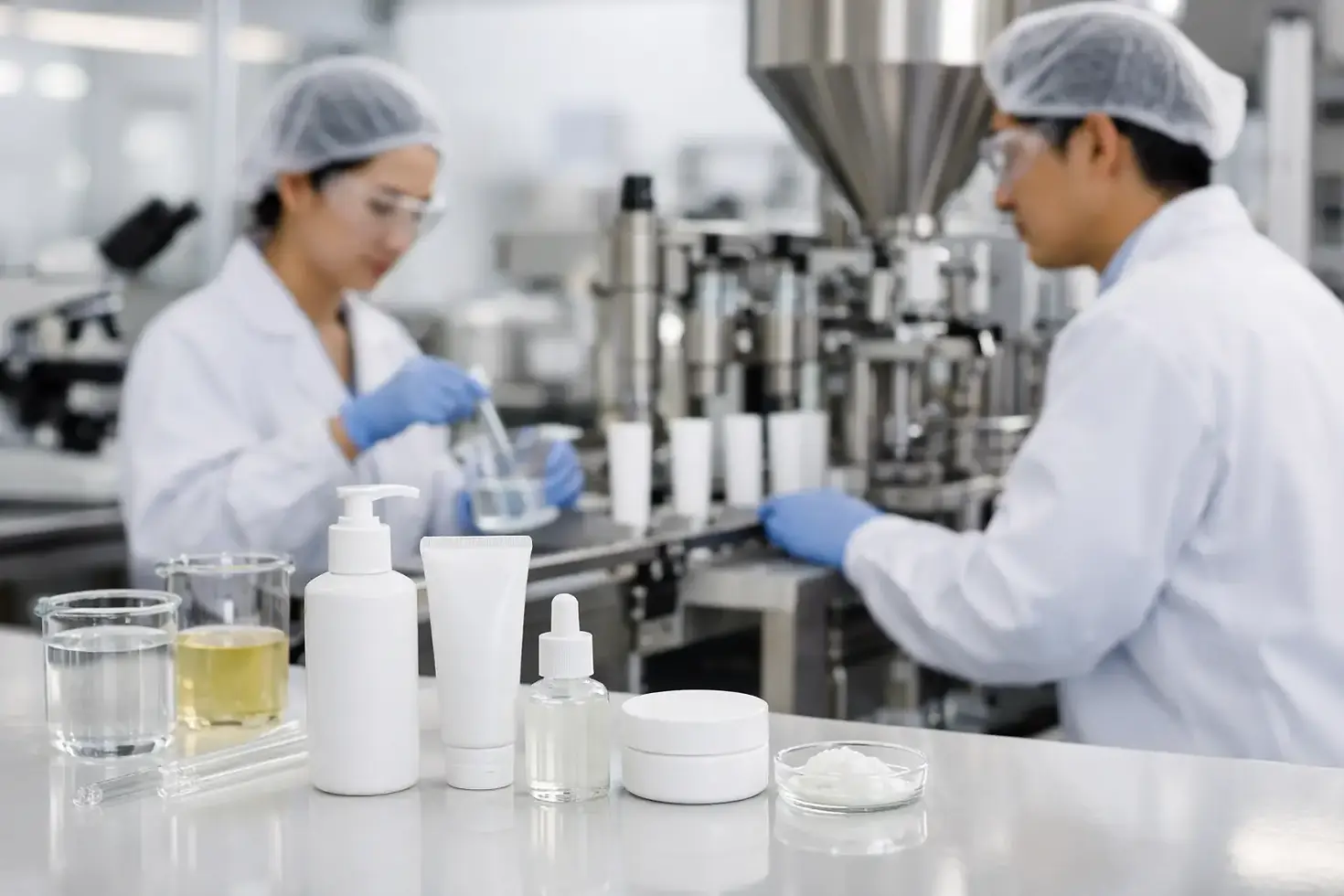
The scope of support matters. A full-service partner can take ownership of research, formulation, prototyping, stability testing, GMP-compliant production, packaging and final delivery. This reduces handovers between suppliers, which can otherwise introduce delays, inconsistent specifications and uncertainty over responsibility when a problem arises.
OEM and ODM services are often discussed together, but the distinction is useful. OEM generally involves manufacturing a product to a brand’s established specification. ODM provides a more involved development route, where the manufacturer contributes formulation concepts and development expertise before producing the finished item. The best route depends on your internal capabilities. A brand with an experienced technical team may require precise OEM execution, whereas a new category entrant may gain more from a collaborative ODM programme.
Start with the commercial brief, not an ingredient list
Many briefs begin with a list of fashionable ingredients. This can be useful, but it is rarely enough to guide successful development. A strong brief defines the consumer, the product format, the intended sensorial experience, the price position, target launch markets and the reason a consumer should choose the product over alternatives.
For example, a botanical serum designed for sensitive skin requires different formulation decisions from a high-performance brightening serum aimed at frequent active skincare users. Both may include naturally derived ingredients, but their active levels, preservation approach, fragrance strategy, texture and claims pathway can differ substantially.
Be clear about the non-negotiables, then leave space for your development partner to recommend the most suitable technical route. Insisting on every initial ingredient can limit formulation flexibility or create incompatibilities. Conversely, an overly broad brief can make it difficult to assess prototypes objectively. The most productive development process balances a clear brand vision with evidence-led formulation advice.
Assess scientific capability before comparing unit prices
Unit cost is commercially important, particularly when planning margins and retail pricing. Yet the cheapest quotation can become expensive if the product requires repeated reformulation, fails stability assessment, experiences filling issues or does not deliver the expected consumer experience.
Ask how the manufacturer approaches formulation development and validation. An in-house research and development laboratory offers a practical advantage: formulators can create and refine prototypes more quickly, investigate ingredient compatibility and respond directly to feedback. This is especially valuable for products featuring sensitive botanical extracts, vitamins, peptides, acids or other performance-led ingredients that need careful handling.
You should also understand how the manufacturer assesses stability. A formula that looks excellent on the day it is mixed may change in colour, odour, viscosity or performance over time. Stability testing helps identify these risks before production. Packaging compatibility should be considered alongside it, because an active formula may behave differently in a glass dropper bottle, airless pump, tube or jar.
Evidence should match the product’s intended position. Some brands need a refined daily moisturiser with clear ingredient rationale and reliable quality controls. Others require a more claims-led product supported by appropriate performance testing. There is no universal testing package. The appropriate level depends on the formulation, target consumer, communication plan and markets where the product will be sold.
Quality systems protect the product and the brand
A premium concept cannot compensate for weak manufacturing discipline. GMP standards provide a structured framework for controlling materials, production processes, hygiene, documentation and traceability. For brand owners, this means greater confidence that batches are made consistently and that quality is managed as a system rather than inspected only at the end.
During supplier evaluation, explore how raw materials are qualified, how batch records are maintained and how deviations are handled. Ask who signs off specifications and whether the production facility can support your required format and expected volumes. These questions may feel operational, but they protect brand reputation long after a launch campaign has finished.
International ambitions introduce further considerations. Product requirements, ingredient restrictions, labelling expectations and documentation can vary by market. A manufacturer experienced in serving international brands can help identify where a single formula and pack design may work across markets, and where adaptation may be sensible. This does not remove the need for market-specific regulatory review, but it makes planning more disciplined from the beginning.
Build packaging into development from day one
Packaging is often treated as the final creative decision. In cosmeceuticals, it is part of product performance. It influences dose control, consumer hygiene, protection from air and light, transport resilience and the perceived value of the product.
An antioxidant-rich formula, for instance, may benefit from packaging that limits repeated exposure to oxygen. A treatment product intended for precise application may need a pump rather than a wide-neck jar. Sustainable packaging objectives may also create trade-offs involving material choice, decoration options, minimum order quantities and product protection.
A manufacturer with packaging capability can coordinate artwork requirements, component sourcing, filling suitability and final assembly. This is preferable to selecting a visually appealing component independently, only to discover later that it leaks, dispenses poorly or is unsuitable for the formula.
Choose a partner that can scale with your ambition
The right production scale is not always the biggest one. Emerging brands need realistic minimum order quantities, accessible technical guidance and a path to repeat orders. Larger brands may need dependable capacity planning, process consistency across higher volumes and confidence that supply can keep pace with demand.
Discuss volumes honestly, including best-case and cautious sales forecasts. A practical manufacturer will help you consider batch size, lead times, component availability and the financial implications of holding stock. If you are testing a new category, a focused initial range may be wiser than launching too many stock-keeping units at once. If demand is already proven, planning production and packaging supply earlier can reduce avoidable pressure close to launch.
Partnership quality is equally significant. Product development involves decisions, revisions and occasional compromises. You need a team that explains what is possible, flags risks early and keeps commercial goals in view. With more than three decades of experience, in-house Singapore R&D and a GMP-certified production facility, Biocomm supports brands in bringing custom product concepts from formulation through to finished, market-ready delivery.
Questions worth asking before you appoint a manufacturer
Before making a final decision, seek clear answers to four practical areas: the development process and prototype timeline; testing and quality-control approach; manufacturing and packaging capabilities; and the support available for your target markets. Ask for the rationale behind recommendations, not only a price schedule.
It is also useful to assess responsiveness during the evaluation stage. Are questions answered precisely? Does the team distinguish between a preference and a technical requirement? Are potential constraints raised early? The working relationship you experience before appointment is often a reliable indication of how development will proceed once the project is underway.
Your brand’s next breakthrough begins with a partner prepared to treat your product as more than a production order. Bring a focused brief, ask for evidence behind every key recommendation, and choose the scientific and manufacturing expertise that gives your idea the best chance to perform in consumers’ hands.


